Low carbon reaches the building site
Insulation, solar generation and carbon mineralisation technologies bring sustainability closer to standard practice.
Professional demand for some sustainable solutions is growing faster than for other material categories. In parallel, research is exploring ways to incorporate carbon dioxide into construction products.
From intention to specification
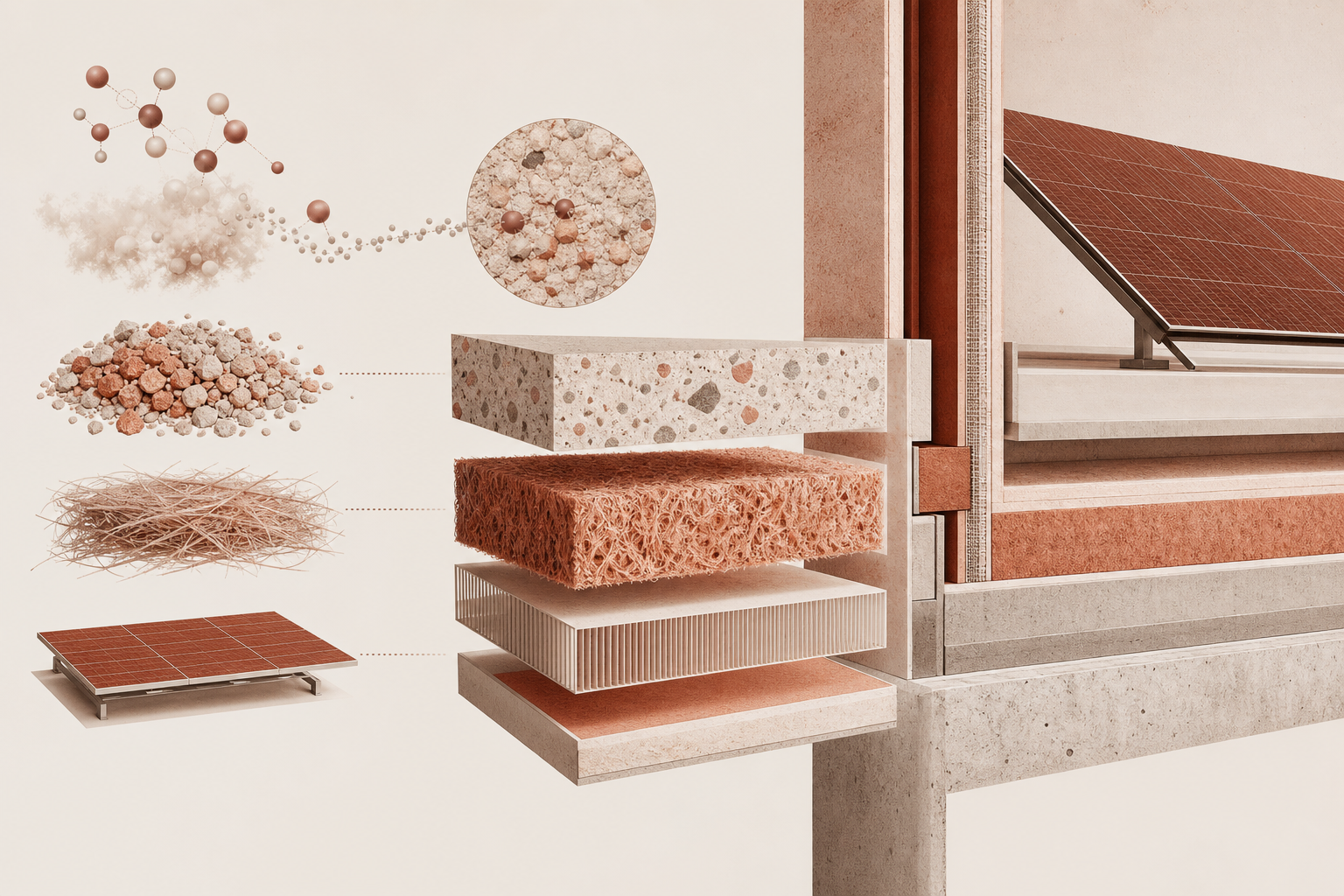
Sustainability in construction is beginning to emerge in routine purchasing and specification decisions. According to data released by a Portuguese materials platform, demand for products considered sustainable is growing at twice the rate of other categories. The most sought-after solutions include photovoltaic modules, solar water-heating systems and high-performance thermal insulation, including rock wool. (idealista.pt)
The indicator comes from one company and does not represent the entire market. Even so, it identifies a practical change: energy efficiency and local energy generation are no longer confined to flagship projects and are becoming part of residential construction at different scales.
Part of this change results from the need to reduce consumption during use. In a context of rising construction costs, efficient solutions face more rigorous assessment of their initial investment. The decision depends on design quality, installation, the building’s orientation and the time needed to recover the cost through energy savings.
Embodied carbon
Efficiency during use is only one environmental dimension. The production of cement, concrete, steel, ceramics, glass and insulation materials also involves energy consumption and emissions. In July 2026, the National Laboratory for Civil Engineering hosted an international conference in Lisbon dedicated to the mineralisation of carbon dioxide in construction materials and products. (lnec.pt)
This field investigates processes in which carbon dioxide is used as a resource and fixed within mineral matrices. The aim is to develop materials with a lower climate impact and create uses for captured carbon streams. The transition from research to the building site will depend on verification of performance, safety, durability, cost, standardisation and industrial capacity.
Material innovation should not be assessed solely by the amount of carbon incorporated. A product must perform its construction function for the intended period, allow maintenance and permit replacement or recycling. A solution with a lower initial impact may lose its advantage if it has a shorter service life or requires disproportionate transport and processing.
Building better with less
The transition does not happen only through new products. Reducing the amount of material used, avoiding unnecessary demolition, reusing components, designing adaptable structures and limiting waste can have an immediate effect. In this respect, refurbishing existing buildings is also a resource conservation strategy.
For buyers and investors, environmental performance should be presented through verifiable information: estimated consumption, thermal characteristics, material origins, maintenance and applicable certifications. Generic terms do not make it possible to compare solutions or anticipate costs.
Growing demand for insulation and solar energy shows that the market already recognises part of this value. Research into carbon mineralisation points towards a more profound change in the composition of materials. Between the two lies the work of architects, engineers, manufacturers and builders: turning environmental objectives into durable, repairable buildings suited to their use.
Sources consulted
Idealista News · LNEC