No. 06
October 2026
Before the first stone
Housing begins with wages, land, planning permission and the capacity to reuse what already exists.
Ama Grupo Imobiliário®
Before the first stone
Housing begins with wages, land, planning permission and the capacity to reuse what already exists.
Editorial Note
A home begins long before construction. It begins with the relationship between income and price, the information available about land, the clarity of the planning process and the capacity to adapt existing buildings to new needs.
Edition no. 6 examines four largely invisible infrastructures. The first is economic: when housing prices rise three times faster than wages, affordability recedes even for those who remain employed and have access to credit. The second is administrative: artificial intelligence can reduce repetitive tasks in the planning process, but it does not remove responsibility, interpretation or transparency. The third is territorial: without a land register and an inventory of public assets, land exists physically but remains unavailable for decision-making. The fourth concerns construction: the former Fábrica Confiança shows how rehabilitation, industrialisation and accommodation policy can converge.
The common theme is preparation. Faster projects are not projects without checks. More land does not mean land without infrastructure. More technology does not replace competent teams. More beds or homes only create a city when they come into use with quality, maintenance and connections to the surrounding area.
Before the first stone lies an entire chain of decisions. Making it legible is a prerequisite for building better.
MATTERS / Ama Grupo Imobiliário®
In this issue
01 · Article
Housing has moved beyond reach three times faster than wages
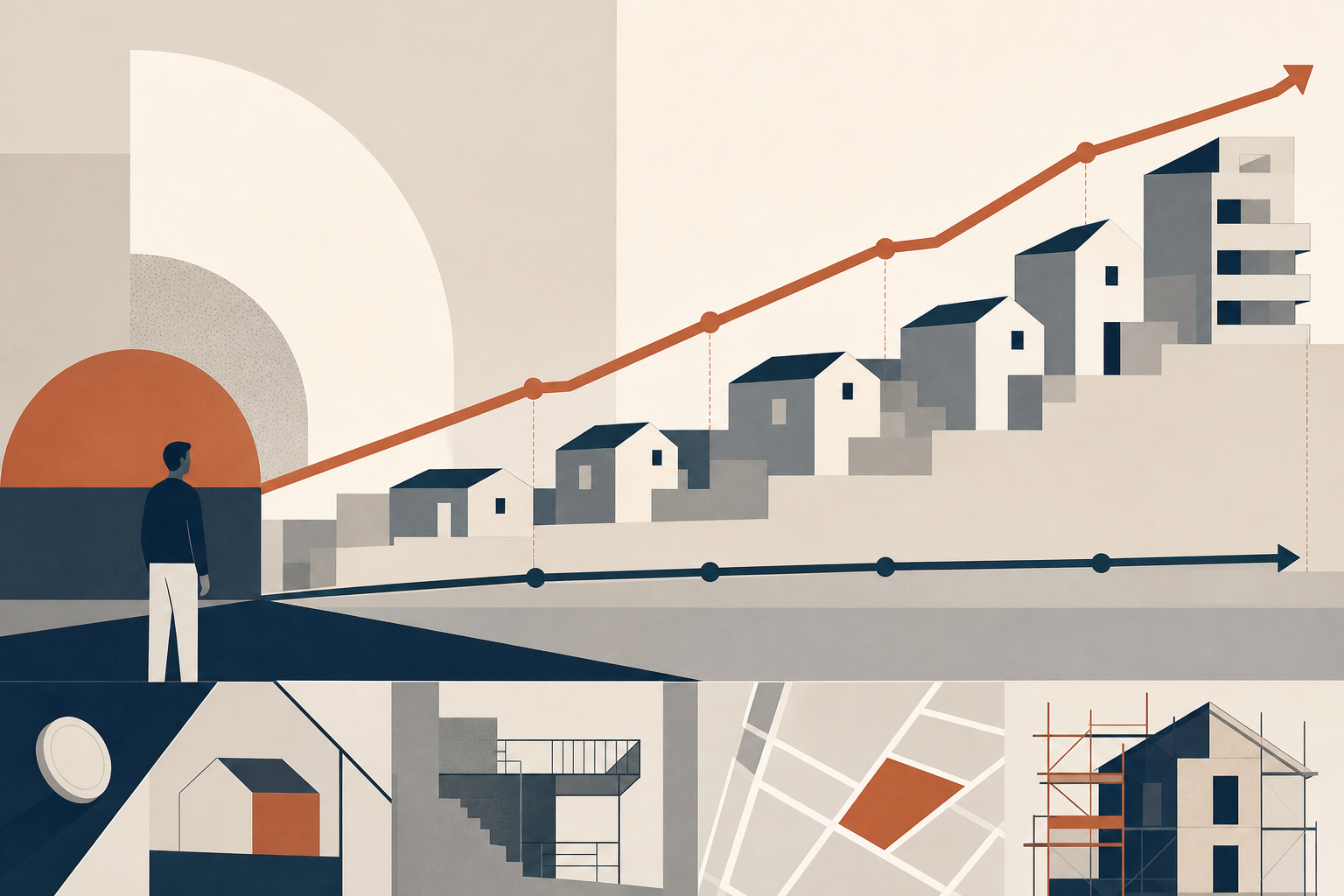
The gap between housing prices and incomes has widened again. The problem is no longer limited to the price per square metre: it involves the deposit, mortgage payments, location and time.
Category: Property and Housing
In the second quarter of 2026, housing prices rose by 16.5% over the year, while average wages increased by 5.1%. The gap changes access, even when credit remains available.
In the second quarter of 2026, the year-on-year rise in housing prices reached 16.5%, while average wages grew by 5.1%. The comparison does not in itself measure the financial burden on each household, but it shows the direction of the imbalance. When the asset rises three times faster than income, purchasing power loses ground even if employment and credit remain stable.
The accumulated gap is more striking over the longer term. Data released in September point to a 182% increase in housing values over a decade, compared with 48% for wages. These figures come from series using different methodologies and should not be confused with changes in each family’s disposable income. Even so, they help explain why demand is shifting towards peripheral areas, smaller property types and arrangements requiring longer mortgage terms.
Price is only the first barrier. The deposit continues to exclude households with enough monthly income to meet mortgage payments but without accumulated savings. Interest rates, insurance, taxes and service charges affect the decision after purchase. Location may reduce the purchase price while increasing daily transport costs. An apparently cheaper home may therefore place greater demands on the household budget.
The market response does not depend solely on increasing the number of listings. Serviced land, approved projects and construction capacity must be converted into completed housing. Supply must also match the property types, locations and price levels that incomes can support. Producing more without controlling costs, timescales and quality may increase volume without improving affordability.
This gap between prices and wages requires a territorial perspective. Lisboa, Margem Sul and Vale do Tejo form a shared residential system, but they do not have the same transport, services or journey times. Affordability should be assessed by the total cost of living, not merely the purchase price.
1. Housing prices grew by 16.5% year on year in the second quarter of 2026, compared with 5.1% for average wages.
2. The deposit, interest, insurance, taxes and mobility weigh as heavily as the advertised price.
3. Greater supply only improves affordability when it reaches the market in locations, property types, timescales and at costs compatible with incomes.
The comparison between price and wage indices indicates a trend; it is not a direct calculation of each family’s housing-cost burden.
The housing problem cannot be solved by choosing between demand and supply. It is solved by bringing income, land, financing, design and delivery closer together. Until that chain becomes shorter, each new price rise will continue to push housing further away from families who work and save but see homes advance faster than their wages.
Sources
- Idealista News
02 · Article
Using AI for planning permission is not the same as letting AI decide
Artificial intelligence can help check documents, cross-reference rules and organise applications. Any time saving will only be credible if there are consistent data, transparent criteria and human decision-making.
Category: Construction and Infrastructure
The pilot projects announced for planning permission may reduce repetitive tasks. Technical and administrative responsibility, however, cannot be automated.
Portugal has launched municipal pilot projects to apply artificial intelligence to planning permission. The stated goal is to bring decision times closer to 50 days. This ambition addresses a problem familiar to developers, designers and municipalities: lengthy procedures, scattered documents, repeated requests for information and rules that are not always interpreted consistently.
Technology can be useful before a decision is made. A system can confirm whether an application contains the mandatory documents, identify inconsistencies between forms, compare areas and parameters, or direct the application to the relevant departments. It can also flag applicable regulations and produce a checklist for the municipal officer. These tasks consume time and are sufficiently structured to benefit from automation.
The limit is reached when checking is confused with deciding. A project is not simply a collection of fields. It involves the urban context, heritage, accessibility, public utilities, safety and effects on third parties. Municipal regulations may contain concepts that require interpretation. Drawings and design statements may be formally consistent yet technically insufficient. The final decision must therefore remain identifiable, reasoned and signed by someone with legal authority.
Data quality will be decisive. If municipalities use outdated databases, incompatible mapping or poorly structured rules, artificial intelligence will merely accelerate errors. It must also be possible to know which version of each regulation was used, what checks were carried out and why an alert was generated. Without an auditable record, applicants cannot understand or challenge the course of the assessment.
Responsible use should begin with low-risk tasks and publicly measured results. Average processing time, the number of requests for clarification, return rates and discrepancies between automated assessment and human decisions should all be compared. A shorter timescale is not enough if it leads to more subsequent corrections, disputes during construction or different treatment of equivalent cases.
Digital planning procedures can make the process predictable. To achieve this, technology must support technical teams rather than replace planning criteria or conceal responsibility.
1. AI can check documentation, cross-reference parameters and organise applications before technical assessment.
2. Decisions must remain human, reasoned, auditable and subject to the legal powers of each authority.
3. Success should be measured by timescale, quality, the number of returned applications and consistency, not merely speed.
Automating the initial checks can free up technical time for the aspects that genuinely require interpretation, coordination and responsibility.
The best application of artificial intelligence to planning will probably be the least spectacular: fewer lost documents, fewer repeated requests and greater clarity about the status of each application. If technology makes the route to a decision visible, 50 days can become a service target. If it merely produces faster answers without explanation, it will be another layer of opacity.
03 · Article
There can be no land policy without a land register
Inventorying assets and locating properties does not automatically create available land. It does, however, provide the basis for deciding what can be transferred, rehabilitated, protected or developed.
Category: Architecture and the City
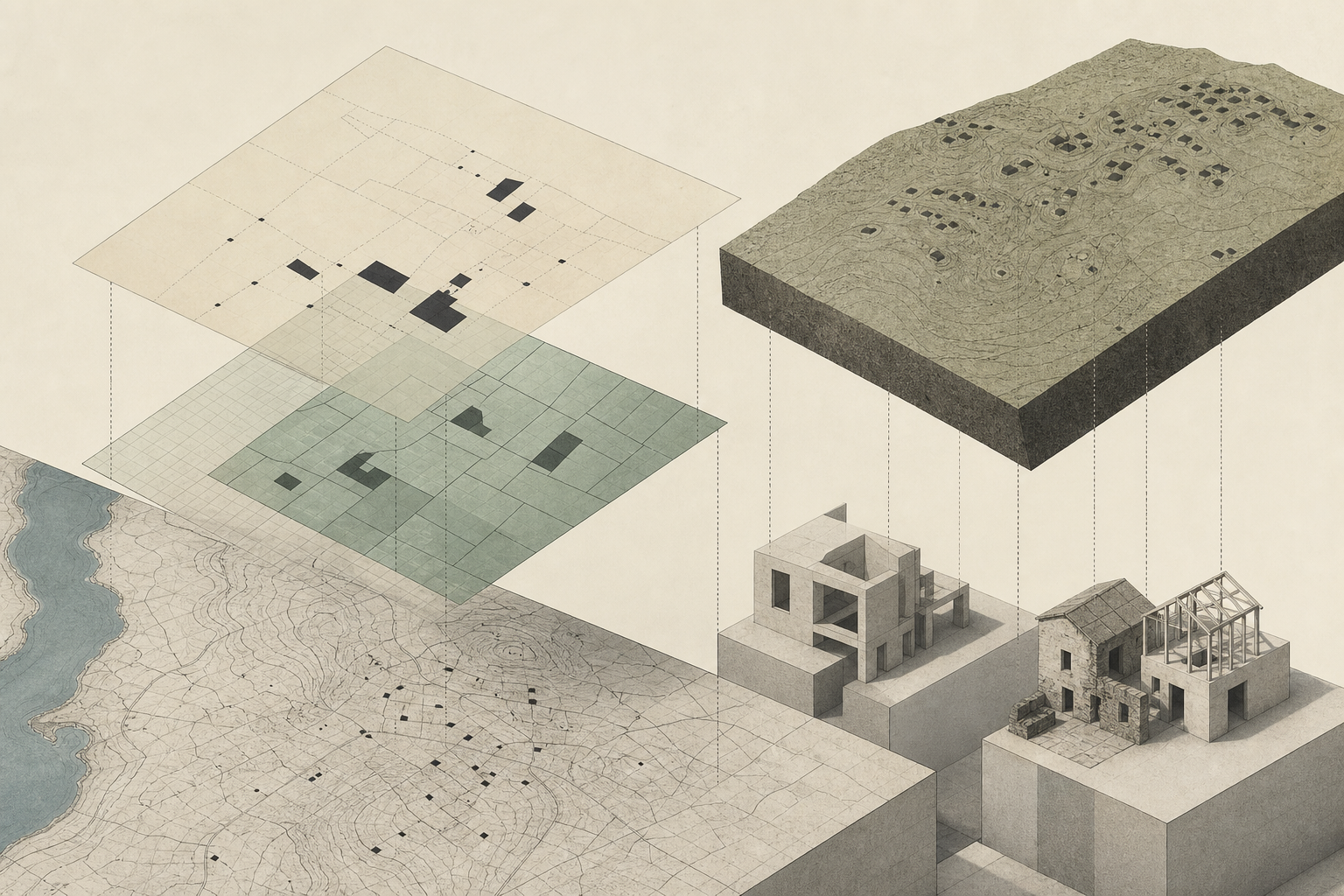
The State has inventoried around 80,000 properties, and BUPi has identified 46% of the area covered by municipalities without a land register. Knowledge of the territory is infrastructure for housing and spatial planning.
Estamo announced that it had registered around 80,000 State-owned properties, most of them rural. Since 2024, 95 assets valued at around 80 million euros have been transferred to 64 municipalities. In parallel, the Balcão Único do Prédio identified 46% of the area of mainland municipalities that did not have a land register.
The two figures describe different tasks, but they converge on the same problem. Land, assets and investment cannot be managed without knowing where properties are, what their boundaries are, who manages them and what constraints apply. The absence of this information delays projects, increases disputes and reduces the capacity to plan housing, infrastructure or fire prevention.
A public inventory is not the same as a portfolio ready for development. Many properties are rural, are occupied, have easements, contain dilapidated buildings, are subject to environmental restrictions or have public uses that should be preserved. Others may be poorly served by transport, water, sewerage or facilities. Before announcing housing capacity, it is necessary to assess location, ownership, planning status, infrastructure costs and the feasibility of adaptation.
Even so, knowledge of the assets changes the quality of decision-making. A municipality can compare acquisition, transfer, rehabilitation and new construction. It can avoid purchasing land when a suitable public asset exists, or recognise early that a particular property does not meet the intended programme. Transparency also makes it possible to scrutinise why an asset is retained, transferred or placed on the market.
BUPi operates at another scale, particularly in areas where rural property had not been georeferenced. Locating registered plots is essential for forest management, network installation, civil protection and land consolidation. It also reduces uncertainty in operations that depend on access, boundaries and compatibility with infrastructure. Georeferencing does not, however, replace registration, spatial planning or the resolution of overlaps.
Portugal frequently discusses the lack of available land. Part of that shortage is physical or regulatory. Another part is informational. Unknown territory, dispersed assets and incompatible databases turn potential assets into deferred decisions.
1. Estamo has inventoried around 80,000 public properties and transferred 95 assets to 64 municipalities since 2024.
2. BUPi identified 46% of the area covered by mainland municipalities without a land register.
3. Inventories and georeferencing do not make a property developable, but they reduce uncertainty and improve decisions about use, investment and protection.
A plot may belong to the State and still be unsuitable for housing. Legal availability, planning suitability and economic viability are separate checks.
The land register rarely appears in the final image of a home, a road or a park. It is, however, at the beginning of all of them. Treating territorial data as public infrastructure makes it possible to prepare projects with fewer surprises, protect what should not be built on and mobilise more quickly what can serve the city.
Sources
- Vida Imobiliária
04 · Article
A factory need not be erased to house students
Residência Universitária Confiança almost doubles the Universidade do Minho’s accommodation capacity in Braga and shows how an industrial building can house a contemporary programme without losing its urban memory.
Category: Architecture and Rehabilitation
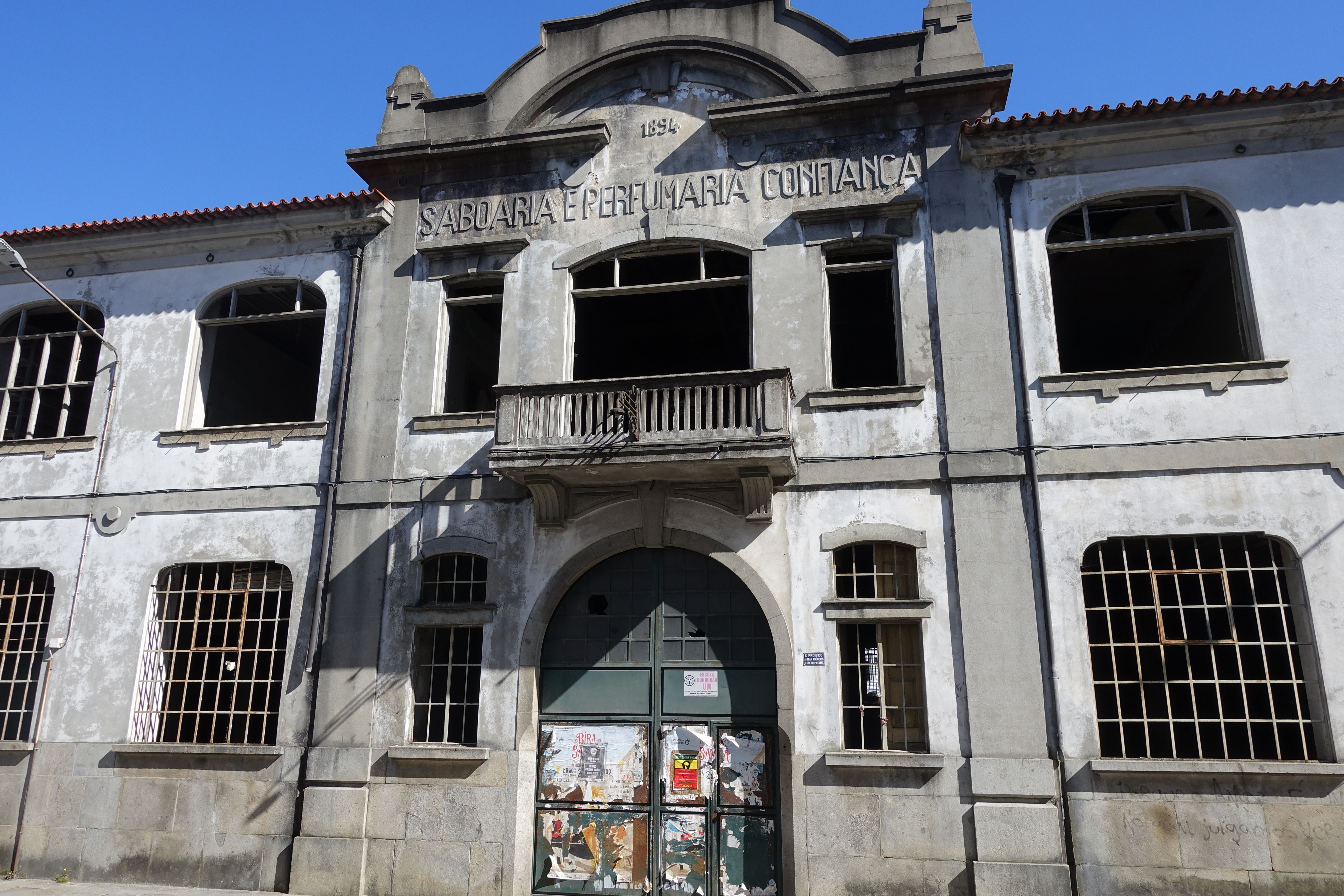
The former Fábrica Confiança in Braga has been converted into a public student residence with 786 beds. The project brings together heritage reuse, industrialised construction and a policy of access to education.
Residência Universitária Confiança opened in Braga with 786 beds. The total investment stated by the Government is 31.1 million euros, of which 29.5 million was financed by the Plano de Recuperação e Resiliência. The operation restored the former factory and added new construction in the courtyard, with management entrusted to the Serviços de Ação Social da Universidade do Minho.
The scale changes the local provision. The university’s accommodation capacity in Braga rises from 855 to 1,631 beds. The new residence does not meet all demand, but it reduces pressure on students living away from home and on the rental market. It also shows that student accommodation is infrastructure for access to education. A university place loses value when the city does not offer a housing solution compatible with the family budget.
The architectural interest lies in the relationship between permanence and transformation. Fábrica Confiança formed part of Braga’s industrial memory. Its reuse means that the programme does not begin on an empty site and allows a recognisable urban landmark to be retained. Preservation does not mean freezing a building in time. It requires decisions about which elements have value, how they accommodate new utilities and safety requirements, and how the new construction can be distinguished without disrupting the whole.
According to the information released about the project, construction used BIM tools, a digital twin and industrialised timber and concrete components. These methods can improve coordination, planning and control, particularly in a repetitive programme such as a residence. Their value does not lie in technological novelty alone. It lies in their capacity to reduce conflicts, prepare assembly and retain useful information for the building’s future operation.
The rehabilitation of industrial structures involves uncertainty. Existing geometry, defects, foundations and the coordination of systems make the project more demanding than modular repetition on an undeveloped site. The combination of survey work, a digital model and prefabricated components can bring together two worlds that are often presented as opposites: conserving existing fabric and building through contemporary processes.
The Braga case should be understood simultaneously as public policy, a construction project and urban transformation. Its quality will be assessed through daily use, maintenance and the relationship that the new programme establishes with the street and the community.
1. The residence adds 786 beds and increases the Universidade do Minho’s accommodation capacity in Braga to 1,631.
2. The intervention combines restoration of the former factory with new construction in the courtyard.
3. BIM, a digital twin and industrialised components supported the coordination of a heritage project with a repetitive programme.
The project’s most significant figure is not merely the number of beds. It is the transformation of a disused industrial building into public infrastructure used every day.
Rehabilitating before demolishing is not an absolute rule. It is a design question. At Fábrica Confiança, the answer preserved an urban presence and created accommodation on a meaningful scale. The lesson lies not in copying the building’s form, but in recognising that heritage, technology and social policy can form part of the same process.
Sources
- Governo de Portugal